The short answer
Use this hub to connect the game’s moving-fortress combat, equipment choices, unlock systems, and region difficulties.
At a glance
- Platform
- PC / Steam
- Developer
- Randwerk
- Publisher
- Sidekick Publishing
- Release stage
- Early Access
- Early Access release
- 2026-09-08
- Game mode
- Single-player
- Genre
- Action roguelike
- Engine
- Unity 6
Explore the Wiki
Start with a practical guide, explore equipment and characters in the database, or catch up on the changes affecting your next run.
| Looking for | Go to |
|---|---|
| A first-run starting point | Beginner guide → |
| Named items and characters | Database → |
| Game updates | Updates → |
A fortress is both your character and your vehicle
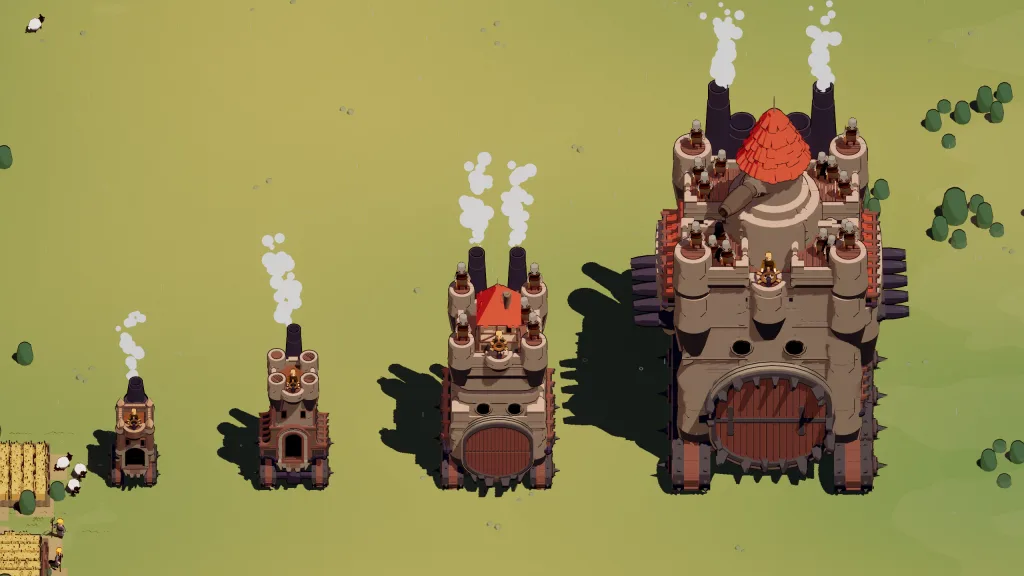
Wanderburg makes movement part of the build. The castle carries the equipment, but it also determines where that equipment is brought into a fight. You are not placing a stationary base and waiting for enemies to arrive. You must steer through a moving ecosystem and judge which targets you can safely approach.
The official press kit describes a procedurally generated map, module upgrades, and further castle growth after defeating bosses. This is why a familiar-looking field is not a fixed route to memorize. Use the current surroundings to choose a path rather than following a coordinate list from another run.
The central idea is a character that occupies the world as a growing fortress. Consumption and fighting belong to the same journey: moving toward something also exposes the castle to whatever is nearby. Thinking only about the next upgrade misses this spatial part of play. Thinking only about driving misses the equipment decisions that determine what you can accomplish once you arrive.
For a new player, the useful overview is therefore a loop of observation, approach, action, and reassessment. That is our way of explaining the game, not a named sequence of official stages. Observe the nearby targets, choose an approach, use the tools available, then reconsider the surroundings after the situation changes. A plan can remain sensible even when the route itself must change.
How the systems fit together
During a run, focus on movement, the equipment you are using, and the next fight. Between runs, additional unlocked choices expand the set of strategies you can try. More options are useful, but they are not proof that every later choice is better than every earlier one.
Vehicles and modules answer different questions even though they appear together on the same castle. A vehicle is the player platform; a module supplies equipment. Changing the platform can alter the experience of delivering an attack without changing what the attack is supposed to do. Tower and Spider are player vehicles, while an enemy that happens to move is not automatically an unlockable vehicle.
This distinction helps explain a common confusing result: a familiar attack may feel less dependable on an unfamiliar setup. Before concluding that the module became weaker, consider whether the approach, selected character rule, or vehicle handling changed. The vehicle database covers platform changes; the controls guide helps separate those changes from input configuration.
| System | What it answers | Where to look |
|---|---|---|
| Modules | What can this fortress do in combat? | Automatic attacks and active abilities |
| Captains | Which character rules or drawbacks apply? | Current captain description |
| Artifacts | Which additional effect or interaction is involved? | Artifact tooltip and version |
| Vehicles | How does the chosen platform handle? | Base behavior and upgrades |
| Biomes | Which environment and difficulty am I entering? | Region name and difficulty label |
Modules, weapons, and active decisions
Modules are the main equipment records in this archive. Official notes distinguish automatic attacks from active abilities, sometimes changing one without strengthening the other. A module therefore needs more context than a single damage label.
Weapons are covered as offensive modules, not as duplicate copies of every module record. Defensive utility also matters: Force Mage’s projectile cancellation is a capability that a pure damage comparison would miss.
Consider two questions when reading about equipment: what happens without an active command, and what additional action becomes available? Release-week balance changes demonstrate why these should stay separate. An improvement to one part can matter greatly to a player who uses it frequently while doing little for a player whose attention is occupied by steering.
For an overview of a build, describe the job of each choice before naming a favorite combination. One action might supply the offense you rely on; another might answer a specific incoming threat. This functional description remains useful when an exact value changes.
Captains and artifacts are different questions
Captains shape your playstyle through character rules and tradeoffs. Artifacts add effects to build around. Start with the captain’s rule, then choose equipment and artifact triggers that suit the actions you use most.
A captain can impose a drawback that changes how you should approach a run. The currently captain records include Nitro, boosting, cooldown, cannon, and gold penalties.
Artifacts deserve equally careful reading. A fix naming Phoenix Feather and Valkyrie confirms an interaction, but does not by itself reveal its trigger, strength, or a guaranteed build combination. Check the individual record before treating an interaction as a recommendation.
The distinction is useful at selection time. With a captain, you are asking how a character-specific rule affects the way you intend to play. With an artifact, you are asking which effect applies and under what conditions. Neither should be treated as an interchangeable bonus simply because both are available through wider progression.
A practical reading order is to understand the chosen captain, inspect the equipment you expect to use, and then check any proposed artifact interaction against its actual description. If one part of that explanation is missing, keep the combination provisional.
Regions, encounters, and difficulty
Grassland, Dark Forest, and Desert are region names. Patch notes also refer to difficulty variants and overtime. A region name alone does not describe the conditions of a run; record the difficulty and whether you continued into overtime.
Bosses are part of castle growth, but an enemy mentioned by name in a fix is not automatically a boss.
Environment is also context for interpreting advice. The Dark Forest composition change illustrates the problem: fewer opponents and weaker opposition are not equivalent descriptions. Look at the conditions behind a recommendation rather than judging the scene only by how busy it appears.
For major encounters, this hub establishes their place in the game, while the boss page concentrates on preparing and recovering from an engagement. Where a named enemy is but its boss status is unresolved, that uncertainty remains attached to the name.
Boss victories expand the castle further. Prepare abilities and an exit before committing to a large fortress, then reassess your surroundings after the fight. Visit the encounter guide for a practical preparation sequence.
Progression now includes unlock-based rerolls
Hotfix 0.9.10 connects the number of unlocked modules and artifacts to additional rerolls. This gives collection progress an effect beyond simply making another item available.
A September launch-week guide can already describe behavior that changed in a later hotfix.
There are three different reasons to begin another attempt: practice the execution of a familiar plan, explore an unlocked option, or pursue a different challenge. Choosing one makes the outcome easier to interpret. An attempt that teaches you a new vehicle can be useful even if it does not also establish that vehicle as your strongest choice.
Use this knowledge map as a starting point rather than a checklist that must be read in order. The beginner guide is for immediate decisions while learning. Progression explains the relationship between attempts. The database is for checking a specific identity or behavior, and the update archive explains why older advice may no longer describe the same game.
For build planning, begin with dependable offense, add a response to incoming threats, and choose artifact interactions that fit your actions. The build guide develops these approaches; the tier pages help prioritize choices for beginners, ability-focused play, and more demanding runs.
Is this wiki a complete item roster?
No. It publishes the names and facts that can currently be traced to official material. Missing effect values are omitted, not treated as zero.
Where should I check a current build claim?
Start with the module or captain record, then read the relevant update. A strong old demonstration does not establish the same result after a balance change.