Quick facts
| Category | Modules |
|---|---|
| Role | Offense |
In-game view
Official Randwerk promotional screenshots from the press-kit archive. Release visuals may differ.
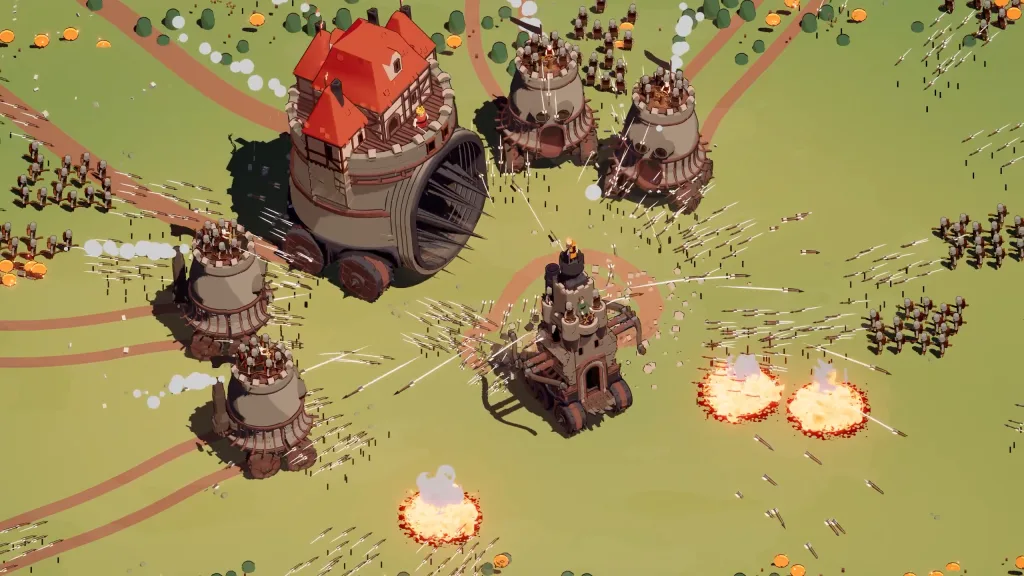
How Side Ballista works
Side Ballista has an automatic attack and an active ability. Hotfix 0.9.9 weakened the automatic attack while strengthening the active ability. These are two different changes within the same module, so the value of the change depends on which part you use.
For a returning player, the practical question is how much your previous setup relied on automatic fire. An old comfortable routine may need more deliberate ability use if you want to explore what the newer version offers.
Role in an active build
Guide advice: treat the active action as an opportunity to plan, not an extra button to press without looking. Identify a useful opening, check readiness, and make the approach with a continuation in mind. Keep watching the castle after the action rather than following only the attack.
A setup can have an attractive active action and still feel awkward if you repeatedly reach targets while it is unavailable. Pay attention to the sequence across several approaches, including the time spent relying on other offense.
When to choose Side Ballista
Consider it when you enjoy active offense and are comfortable dividing attention between steering and ability use. It is also worth revisiting if you dismissed the active action before the 0.9.9 change.
If your preferred style relies heavily on automatic attacks, compare that part directly with alternatives such as Side Arm. Do not assume an active-ability improvement delivers the same benefit to an automatic-focused setup. The decision should match what you actually use during combat.
Strengths and weaknesses to weigh
The combination of automatic and active components gives you two parts to assess within one offensive choice. For an ability-focused player, the active side provides a deliberate contribution to plan around.
The main practical weakness to watch is a mismatch between the choice and your habits. If you rarely activate the ability, your experience will lean toward the automatic component that was reduced in 0.9.9. If you focus only on activation, you may overlook unsafe movement or the interval before the next useful opportunity.
Complementary roles and captain considerations
Front Barracks is a useful comparison when selecting an active offensive plan. Force Mage addresses a different role: answering incoming projectiles that disrupt an approach. Compare the missing function first, rather than treating every equipment choice as another damage ranking.
Huntress deserves attention in an ability-centered setup because of her cooldown drawback. Read the character rule alongside the action you want to repeat. That interaction is a timing consideration; it does not automatically make the captain a preferred pairing or a choice to reject.
Beginner tips and common mistakes
Begin by noticing when automatic attacks contribute and when the active action changes the situation. Try a manageable encounter so the two are easier to distinguish. Keep your vehicle and captain familiar while learning that difference.
Avoid calling the module stronger or weaker based on one patch sentence. Avoid copying a demonstration without checking which component it emphasizes. Most of all, avoid activating into a poor route just because the ability is ready: the next position remains part of the offensive decision.
Patch notes
A module whose automatic attack and active ability were adjusted in opposite directions: the automatic attack was weakened, while the active ability was strengthened.
Hotfix 0.9.9 →Side Ballista FAQ
What changed for Side Ballista?
Hotfix 0.9.9 reduced automatic attack strength and increased active ability strength.
Who should consider it?
Players interested in deliberate ability use can explore its active-focused role. Automatic-focused players should compare the automatic component separately.
Is it always better than Side Arm?
Choose according to the action your build uses and the conditions of the run. They should be compared at similar rarity and upgrade stages.
What is a useful first exercise?
Observe an approach using ordinary offense, then deliberately use the active action during a manageable opportunity and compare the sequence.