Quick facts
| Category | Modules |
|---|---|
| Role | Contact offense |
In-game view
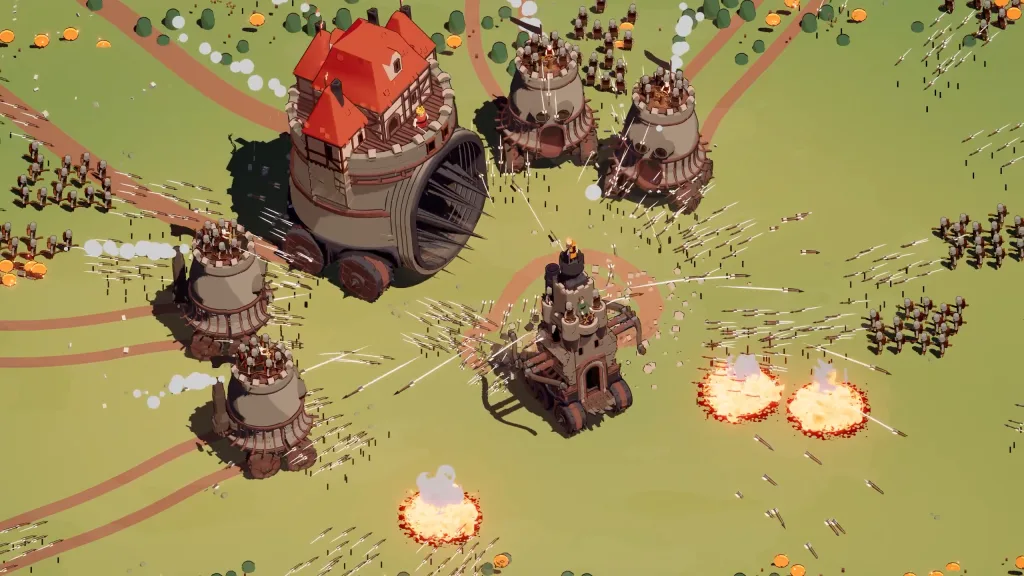
Official Randwerk promotional screenshots from the press-kit archive. Release visuals may differ.
What Ram does
Ram is a module with contact-oriented behavior. Hotfix 0.9.8 fixed inconsistent damage following earlier behavior and visual corrections. Its role puts the movement of the vehicle itself at the center of how you apply the attack.
This makes it a different practical question from activating offense while concentrating on a more distant route. You need to understand how the fortress reaches the target and where that commitment leaves you.
Plan the entire pass
Guide advice: look at the target, the approach, and the space beyond it before committing. A useful pass should include a way to continue or turn away if the opponent remains dangerous. Getting close is the beginning of the decision, not proof that the attack is a good trade.
After a difficult pass, identify what failed. Missing the intended line suggests an approach problem; landing the action and ending among other threats suggests a recovery problem. Those call for different adjustments.
When to choose Ram
Consider Ram when you enjoy active vehicle maneuvers and want to make driving part of the offensive plan. It is a more manageable experiment once you can steer a familiar platform comfortably through a chosen route.
If you are still struggling to control turns and direction changes, practice those first. The next equipment choice does not have to add more commitment while you learn the platform. You can return to a contact approach once you can anticipate where the castle will finish.
Strengths and tradeoffs
The appeal of contact-oriented play is a clear connection between driving and offense. It gives each approach a purpose and rewards paying attention to the entire path through an engagement.
The tradeoff is exposure and commitment. An impressive hit can still leave you in a worse position, especially when several threats overlap. Judge whether the sequence is repeatable without relying on every attack finishing the target immediately. Keep an alternative route when the approach becomes crowded.
Vehicle, captain, and module considerations
Tower and Spider are useful vehicle pages to read when thinking about platform handling. Learn the chosen platform before attributing an awkward pass to Ram itself. Starting movement and later upgrades can produce different experiences.
Duelist’s additional incoming damage while boosting and Tankbert’s Nitro-recovery drawback are relevant risks to consider if boosting is part of your approach. They are not automatic Ram recommendations. Force Mage offers a different role to examine when projectiles complicate the line you want to take.
Beginner routine and mistakes
Practice with one familiar vehicle and an uncomplicated approach. Decide where to go afterward, make the pass, and inspect the result. If the exit is uncomfortable, use the next attempt to change the route rather than immediately adding another unfamiliar captain rule.
Avoid boosting toward every target without considering recovery. Avoid repeating a failed line simply because the first hit looked promising. Finally, use current behavior when judging damage consistency: the module received a relevant fix in 0.9.8, so older collision experiences may feel different.
Patch notes
A module with contact-oriented behavior. Hotfix 0.9.8 fixed inconsistent damage after earlier behavior and visual corrections.
Hotfix 0.9.8 →Ram FAQ
What kind of module is Ram?
It is a contact-oriented offensive module that makes vehicle positioning central to its use.
What changed in 0.9.8?
The hotfix corrected inconsistent damage.
Is Ram a good first experiment?
It is easier to learn after steering feels comfortable. Use a familiar vehicle and practice an approach with a clear continuation.
Does boosting always make a pass safer?
Plan around Nitro availability and your captain’s rule. Duelist has a damage drawback during boost, so boost itself is not a universal safety plan.